Sciatica
Shooting leg pain? Let's find the root cause.
"Doc, I've got this pain shooting down my leg." It's one of the most common complaints we hear — and the culprit is often sciatica. But is what you're feeling truly sciatica, or something else entirely? Here's how to tell.
What it is
Sciatica is a symptom — not a diagnosis
Sciatica consists of leg pain, which might feel like a bad leg cramp, or it can be excruciating, shooting pain that makes standing or sitting nearly impossible. The pain might be worse when you sit, sneeze, or cough. Sciatica can occur suddenly or develop gradually.
You might also feel weakness, numbness, or a burning or tingling ("pins and needles") sensation down your leg, possibly even in your toes. Less common symptoms might include the inability to bend your knee or move your foot and toes.
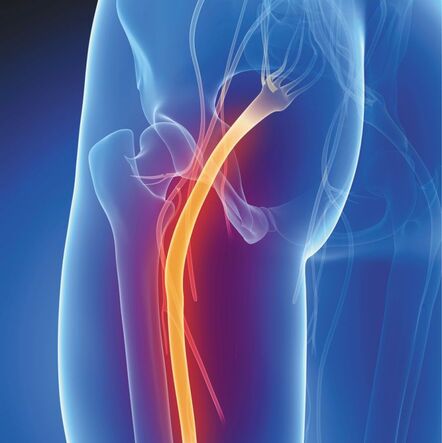
The sciatic nerve is the longest and thickest nerve in your body. It originates in your lower back, travels through your buttocks, and branches down each leg, all the way to your feet. When this nerve gets irritated, compressed, or inflamed, it causes the radiating pain we call sciatica.

Signs & symptoms
Is it really sciatica? Key indicators
While only a thorough examination by a healthcare professional can give you a definitive diagnosis, these are the classic signs that often point to sciatica:
- Characteristic pain pattern: pain radiating from your lower back or buttock down into one leg — it rarely affects both legs equally
- Specific pain location: pain follows the sciatic nerve — down the back of the thigh, into the calf, sometimes into the foot and toes
- Numbness or tingling: "pins and needles" in the affected leg or foot, indicating nerve irritation
- Muscle weakness: difficulty lifting the foot (foot drop) or weakness when walking or standing
- One side only: sciatica almost always affects only one side of the body at a time
Relieving factors can offer temporary relief: lying down — especially on your back with knees bent — or walking slowly.
Causes
What causes sciatica?
Sciatica itself isn't a disease — it's a symptom of an underlying problem irritating the sciatic nerve. The nerve might be pinched inside or outside of the spinal canal as it passes into the leg. Common causes we see in practice:
- Herniated or slipped disc: the most common cause — a disc bulges or ruptures and presses directly on the sciatic nerve root
- Spinal stenosis: narrowing of the spinal canal, putting pressure on the nerves
- Piriformis syndrome: the piriformis muscle, deep in the buttock, becomes tight or spasms and compresses the sciatic nerve
- Spondylolisthesis: one vertebra slips forward over another, narrowing the opening the nerve exits through
- Degenerative disc disease: age-related wear and tear on the spinal discs
A complete medical history, a review of your symptoms, and a physical exam help diagnose sciatica and determine its cause. Your provider may perform a straight-leg-raise test, in which you lie on your back with your legs straight and each leg is slowly raised — the elevation at which your pain begins helps pinpoint the affected nerves and whether a disc is involved.
Treatment
How we treat sciatica
Our approach focuses on identifying the root cause of your nerve irritation. Through a comprehensive examination — including orthopedic and neurological tests, and potentially imaging if needed — we develop a personalized treatment plan.
- Gentle spinal adjustments to relieve nerve irritation and restore proper spinal function
- Therapeutic exercises and stretches tailored to your condition
- Ice/cold therapies, ultrasound, and EMS as appropriate for your case
- Lifestyle advice to help alleviate pain and prevent future flare-ups
The purpose of chiropractic treatment is to help the body's potential to heal itself — it is based on the scientific principle that restricted spinal movement leads to pain and reduced function and performance. Care is non-invasive (non-surgical) and drug-free, and the type of therapy provided depends on the cause of your sciatica.
When to see a chiropractor: while some mild cases may resolve on their own with rest and conservative measures, many require intervention. Definitely seek professional help if your pain is severe, unrelenting, or progressively worsening; if numbness or weakness is significant or getting worse; if you lose bowel or bladder control (this is a medical emergency — get immediate attention); or if your sciatica follows a traumatic injury.
Not all leg pain is sciatica. If your pain stays above the knee or centers in the joint, see our leg pain causes & treatment page — or our low back pain treatment page if the pain never leaves your back.
Get treated for sciatica today →FAQ
Sciatica questions, answered
How do I know if I have sciatica?
The hallmark is pain radiating from your lower back or buttock down into one leg, often with numbness, tingling, or weakness. Sitting, sneezing, coughing, or bending forward typically make it worse. Only a thorough examination can give a definitive diagnosis.
What causes sciatica?
Sciatica is a symptom of an underlying problem irritating the sciatic nerve. The most common cause is a herniated or slipped disc pressing on the nerve root; other causes include spinal stenosis, piriformis syndrome, spondylolisthesis, and degenerative disc disease.
When should I see a chiropractor for sciatica?
Seek professional help if your pain is severe, unrelenting, or progressively worsening; if numbness or weakness is significant or getting worse; if you lose bowel or bladder control (a medical emergency); or if your sciatica follows a traumatic injury.
How is sciatica diagnosed?
A complete medical history, a review of your symptoms, and a physical exam help diagnose sciatica and determine its cause. A straight-leg-raise test can help pinpoint the affected nerves and reveal whether a disc is involved.
Don't let leg pain run
your life.
That's what the $29 first visit is for — a comprehensive exam, a real conversation, and a plan built around you.
Book your $29 first visit →